1. Initiate
1 mastered domains and previous cape tier.
Beyond the full ASCEND suit
Only a confirmed student account with all ten fully earned ASCEND powers can start Plus. Previewing the full suit, self-study completion, XP alone and teacher roles cannot unlock it.
Continue ASCEND →Sign in to see your eligibilityArtwork preview — not earned or saved
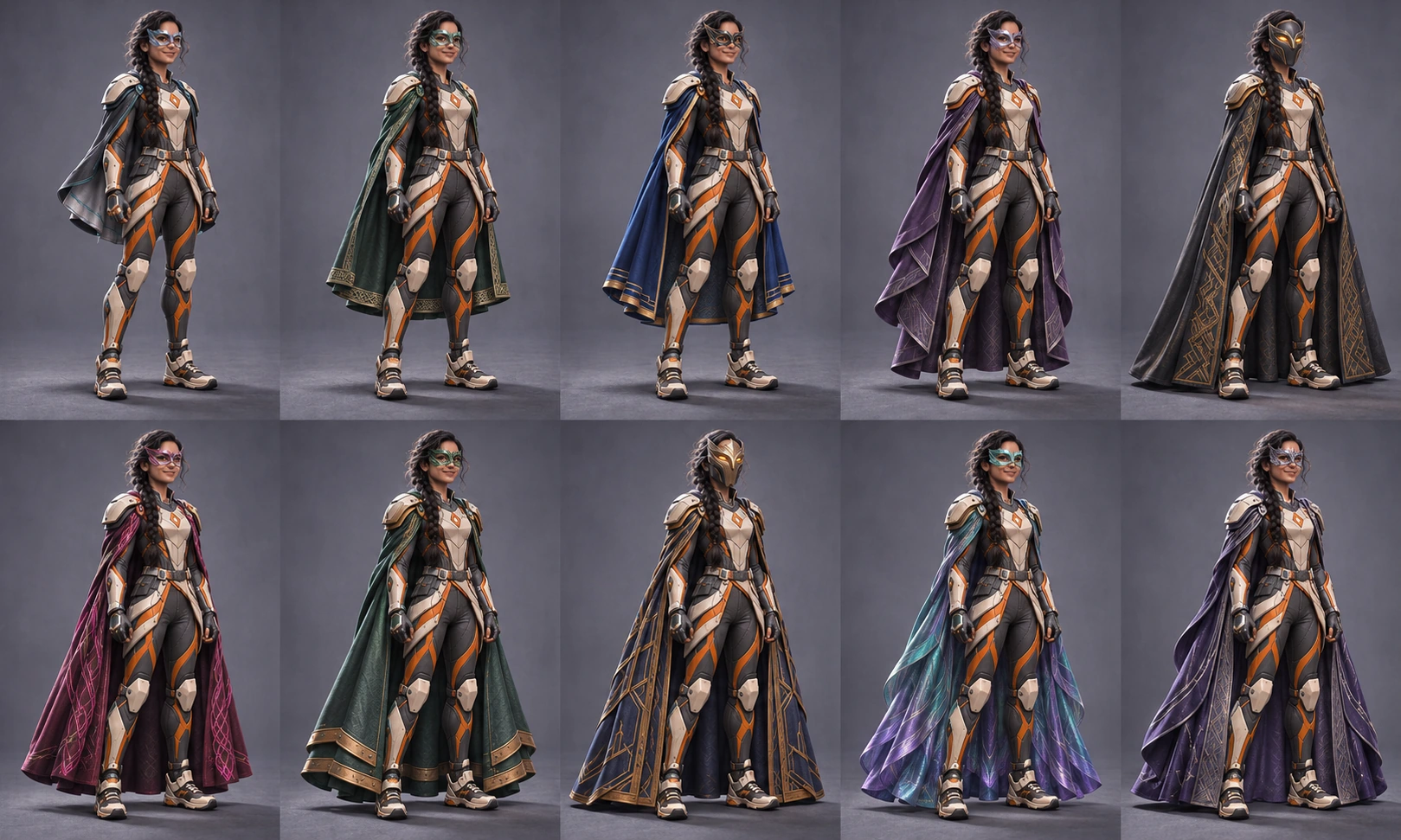
Preview every set. Earn six Diagnose certificates for a mask, six Apply certificates to activate its power, then six Transfer certificates after 24 hours to master it. A cape trial combines mastered domains. No deadline or streak penalty.
Preview only — this demonstration grants no progress
A scanning line follows successive execution states. Trace statements in order to locate the first mismatch.
Character and suit previews are local. Save your character and suit in ASCEND. Named powers are cosmetic recognition, not tools that change grades or answer questions.
0/10 masks mastered · 0/10 capes earned · 0/190 missions verified
Paths 1–3 open first. Two mastered paths open 4–6, five open 7–9, and nine open Singularity. Every numeric field must pass; guided attempts and replays award no extra credit. Plus never adds base XP.
1. Boundary debugging
AP CSP 1.4 · CRD-2.I, CRD-2.J
2. Preserve state
AP CSP 3.1 · AAP-1.A, AAP-1.B
3. Nested branches
AP CSP 3.7 · AAP-2.I
4. List edits
AP CSP 3.10 · AAP-2.N, AAP-2.O
5. Return placement
AP CSP 3.12 · AAP-3.A
6. Search intervals
AP CSP 3.11 · AAP-2.P
1. Range contracts
AP CSP 3.13 · AAP-3.B, AAP-3.C
2. Empty collections
AP CSP 3.2 · AAP-1.C, AAP-1.D
3. Boolean requirements
AP CSP 3.5 · AAP-2.E, AAP-2.F
4. Procedure arguments
AP CSP 3.12 · AAP-3.A
5. List abstraction
AP CSP 3.2 · AAP-1.C, AAP-1.D
6. Unsigned limits
AP CSP 2.1 · DAT-1.A, DAT-1.B, DAT-1.C
1. Linear search
AP CSP 3.11 · AAP-2.P
2. Ordered halving
AP CSP 3.11 · AAP-2.P
3. Polynomial work
AP CSP 3.17 · AAP-4.A
4. Parallel makespan
AP CSP 4.3 · CSN-2.A, CSN-2.B
5. Serial bottleneck
AP CSP 4.3 · CSN-2.A, CSN-2.B
6. Heuristic limits
AP CSP 3.17 · AAP-4.A
1. Counterexamples
AP CSP 3.9 · AAP-2.L, AAP-2.M
2. Boolean equivalence
AP CSP 3.5 · AAP-2.E, AAP-2.F
3. Inclusive randomness
AP CSP 3.15 · AAP-3.E
4. Model assumptions
AP CSP 3.16 · AAP-3.F
5. Undecidable claims
AP CSP 3.18 · AAP-4.B
6. Approximate solutions
AP CSP 3.17 · AAP-4.A
1. Data minimisation
AP CSP 5.6 · IOC-2.A, IOC-2.B, IOC-2.C
2. Authentication
AP CSP 5.6 · IOC-2.A, IOC-2.B, IOC-2.C
3. Key roles
AP CSP 5.6 · IOC-2.A, IOC-2.B, IOC-2.C
4. Suspicious messages
AP CSP 5.6 · IOC-2.A, IOC-2.B, IOC-2.C
5. Asset permission
AP CSP 5.5 · IOC-1.F
6. Linked identifiers
AP CSP 2.3 · DAT-2.A, DAT-2.B, DAT-2.C
1. Sequential totals
AP CSP 4.3 · CSN-2.A, CSN-2.B
2. Independent tasks
AP CSP 4.3 · CSN-2.A, CSN-2.B
3. Coordination cost
AP CSP 4.3 · CSN-2.A, CSN-2.B
4. Task allocation
AP CSP 4.3 · CSN-2.A, CSN-2.B
5. Distributed work
AP CSP 4.3 · CSN-2.A, CSN-2.B
6. Dependency chains
AP CSP 4.3 · CSN-2.A, CSN-2.B
1. Valid paths
AP CSP 4.2 · CSN-1.E
2. Endpoint isolation
AP CSP 4.2 · CSN-1.E
3. Missing packets
AP CSP 4.1 · CSN-1.A, CSN-1.B, CSN-1.C, CSN-1.D
4. Duplicate packets
AP CSP 4.1 · CSN-1.A, CSN-1.B, CSN-1.C, CSN-1.D
5. Naming and Web
AP CSP 4.1 · CSN-1.A, CSN-1.B, CSN-1.C, CSN-1.D
6. Capacity and delay
AP CSP 4.1 · CSN-1.A, CSN-1.B, CSN-1.C, CSN-1.D
1. User requirements
AP CSP 1.3 · CRD-2.E, CRD-2.F, CRD-2.G, CRD-2.H
2. Input and output
AP CSP 1.2 · CRD-2.A, CRD-2.B, CRD-2.C, CRD-2.D
3. Shared review
AP CSP 1.1 · CRD-1.A, CRD-1.B, CRD-1.C
4. Iterative development
AP CSP 1.3 · CRD-2.E, CRD-2.F, CRD-2.G, CRD-2.H
5. Data joins
AP CSP 2.4 · DAT-2.D, DAT-2.E
6. Library contracts
AP CSP 3.14 · AAP-3.D
1. Cleaning means
AP CSP 2.4 · DAT-2.D, DAT-2.E
2. Metadata and scope
AP CSP 2.3 · DAT-2.A, DAT-2.B, DAT-2.C
3. Compression overhead
AP CSP 2.2 · DAT-1.D
4. Rounding and sampling
AP CSP 2.1 · DAT-1.A, DAT-1.B, DAT-1.C
5. Group rates
AP CSP 5.3 · IOC-1.D
6. Association limits
AP CSP 2.3 · DAT-2.A, DAT-2.B, DAT-2.C
1. Purpose and access
AP CSP 5.2 · IOC-1.C
2. Crowdsourced quality
AP CSP 5.4 · IOC-1.E
3. Procedural reuse
AP CSP 3.13 · AAP-3.B, AAP-3.C
4. Nested route synthesis
AP CSP 3.6 · AAP-2.G, AAP-2.H
5. Ethical stakeholder trade-offs
AP CSP 5.1 · IOC-1.A, IOC-1.B
6. Evidence-based repair
AP CSP 1.4 · CRD-2.I, CRD-2.J
1 mastered domains and previous cape tier.
2 mastered domains and previous cape tier.
3 mastered domains and previous cape tier.
4 mastered domains and previous cape tier.
5 mastered domains and previous cape tier.
6 mastered domains and previous cape tier.
7 mastered domains and previous cape tier.
8 mastered domains and previous cape tier.
9 mastered domains and previous cape tier.
10 mastered domains and previous cape tier.
Original AP CSP practice using the current 2026–27 framework; not official AP questions, grading or Create-task evidence. These structured tasks check finite reasoning models, not arbitrary code or unrestricted proofs.